Bitte melde dich an oder registriere dich, um fortfahren zu können.
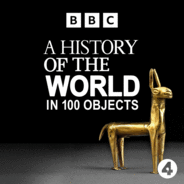
A History of the World in 100 Objects-Logo

Kultur & Gesellschaft

A History of the World in 100 Objects

Director of the British Museum, Neil MacGregor, narrates 100 programmes that retell humanity's history through the objects we have made.

Jetzt anhören
  • im Online-Player
  • im phonostar-Player
  • Was ist das?
    Radio hören mit phonostar Help layer phonostarplayer Um Radio anzuhören, stehen dir bei phonostar zwei Möglichkeiten zur Verfügung: Entweder hörst du mit dem Online-Player direkt in deinem Browser, oder du nutzt den phonostar-Player. Der phonostar-Player ist eine kostenlose Software für PC und Mac, mit der du Radio unabhängig von deinem Browser finden, hören und sogar aufnehmen kannst. ›››› phonostar-Player gratis herunterladen X

Folgen von A History of the World in 100 Objects

101 Folgen
  • Folge vom 04.06.2010
    Arabian bronze hand
    Throughout this week Neil MacGregor is looking at how the great faiths were creating new visual aids to promote devotion around the world of 1700 years ago. Having looked at emerging images from Hinduism, Zoroastrianism, Christianity and Buddhism he turns his attention to the religious climate of pre-Islamic Arabia. The story is told through a life sized bronze hand cut at the wrist and with writing on the back. It turns out to be not a part of a god but a gift to a god in a Yemeni hill village. Neil uses this mysterious object to explore the centrality of Arabia at this period, with its wealth of local gods and imported beliefs. The hand surgeon Jeremy Field considers whether this was the modelled from a real human hand while the religious historian Philip Jenkins reflects on what happens to the old pagan gods when a brand new religion sweeps into town. Proudcer: Anthony Denselow
    Jetzt anhören
    • im Online-Player
    • im phonostar-Player
    • Was ist das?
      Radio hören mit phonostar Help layer phonostarplayer Um Radio anzuhören, stehen dir bei phonostar zwei Möglichkeiten zur Verfügung: Entweder hörst du mit dem Online-Player direkt in deinem Browser, oder du nutzt den phonostar-Player. Der phonostar-Player ist eine kostenlose Software für PC und Mac, mit der du Radio unabhängig von deinem Browser finden, hören und sogar aufnehmen kannst. ›››› phonostar-Player gratis herunterladen X
  • Folge vom 03.06.2010
    Hinton St Mary Mosaic
    This week Neil MacGregor is exploring how many of the great religions, less than 2000 years ago, began creating sophisticated new images to aid prayer and focus devotion. Many of the artistic conventions created then are still with us. In today's programme Neil MacGregor introduces us to one of the earliest known images of the face of Christ. This life sized face is part of a much bigger mosaic. It was made somewhere around the year 350 and was found not in a church but on the floor of a Roman villa in Dorset. What does this astonishing survival say about the state of Christianity at this time and what sort of Christ was imagined in Roman Britain? The historians Dame Averil Cameron and Eamon Duffy help paint the picture. Producer: Anthony Denselow
    Jetzt anhören
    • im Online-Player
    • im phonostar-Player
    • Was ist das?
      Radio hören mit phonostar Help layer phonostarplayer Um Radio anzuhören, stehen dir bei phonostar zwei Möglichkeiten zur Verfügung: Entweder hörst du mit dem Online-Player direkt in deinem Browser, oder du nutzt den phonostar-Player. Der phonostar-Player ist eine kostenlose Software für PC und Mac, mit der du Radio unabhängig von deinem Browser finden, hören und sogar aufnehmen kannst. ›››› phonostar-Player gratis herunterladen X
  • Folge vom 02.06.2010
    Silver plate showing Shapur II
    Throughout this week Neil MacGregor is describing how people across the globe around 1700 years ago found new images to express their religious beliefs. Today's object is a dramatic visualisation of power and faith in 4th Century Iran. It is a silver plate that shows King Shapur II out hunting deer. Neil describes how this apparently secular image reveals the beliefs of the day, when the king was seen as the agent of god and the upholder of the state religion - Zoroastrianism. How might we read this hunting scene as a religious image? And why did the belief system of such a powerful dynasty fail to become a dominant world religion? With contributions from the historian Tom Holland and the Iranian art historian Guitty Azarpay.Producer: Anthony Denselow
    Jetzt anhören
    • im Online-Player
    • im phonostar-Player
    • Was ist das?
      Radio hören mit phonostar Help layer phonostarplayer Um Radio anzuhören, stehen dir bei phonostar zwei Möglichkeiten zur Verfügung: Entweder hörst du mit dem Online-Player direkt in deinem Browser, oder du nutzt den phonostar-Player. Der phonostar-Player ist eine kostenlose Software für PC und Mac, mit der du Radio unabhängig von deinem Browser finden, hören und sogar aufnehmen kannst. ›››› phonostar-Player gratis herunterladen X
  • Folge vom 01.06.2010
    Gold coin of Kumaragupta I
    This week Neil MacGregor is exploring how several of the great religions around the world, less than 2000 years ago, began creating sophisticated new images to represent their beliefs and their deities. Many of the images created then are still with us today and remain essential forms of veneration. These include the images of the gods and goddesses of Hinduism, whose recognisable modern form can be seen on coins from the Gupta empire which flourished in India from around 320 to 550 AD. The Gupta period is regarded by many Indians as a golden age, a time when Indian cultural life and religion came together to create temples and texts that are central to Hinduism today. The growing sophistication of the time is explored with the help of the historian Romila Thapar and the Hindu cleric Shaunaka Rishi Das Producer: Anthony Denselow
    Jetzt anhören
    • im Online-Player
    • im phonostar-Player
    • Was ist das?
      Radio hören mit phonostar Help layer phonostarplayer Um Radio anzuhören, stehen dir bei phonostar zwei Möglichkeiten zur Verfügung: Entweder hörst du mit dem Online-Player direkt in deinem Browser, oder du nutzt den phonostar-Player. Der phonostar-Player ist eine kostenlose Software für PC und Mac, mit der du Radio unabhängig von deinem Browser finden, hören und sogar aufnehmen kannst. ›››› phonostar-Player gratis herunterladen X